A driving tip for Slovenia

One thing you notice driving on the highways in Slovenia is that they have great roads – on a par with the best in Europe in terms of width, smoothness, etc.

How does a country of 2 million people maintain such a great road network? We wondered this as we drove from Italy to Slovenia’s capital Lubiana recently without having to pay any tolls.

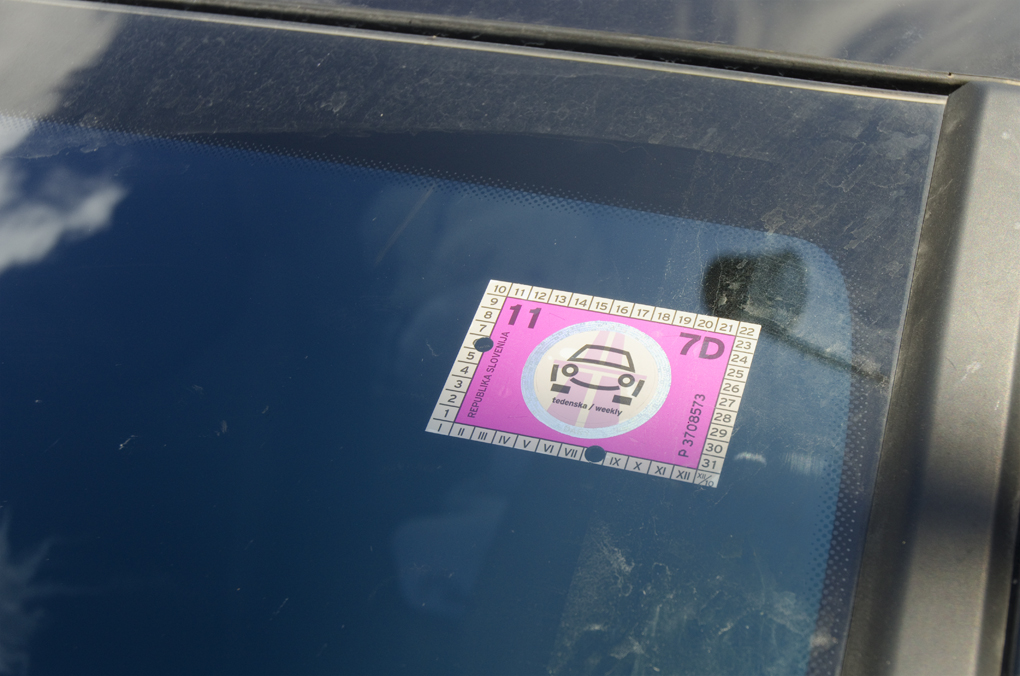
We discovered they do, in fact, have a toll system but one that differs from the usual take a ticket and pay system that operates in Italy and France. They run a Vignette system. You purchase a windscreen sticker which covers a period of time – 7 days up to 12 months. Get caught driving without a valid sticker on your windscreen and a fine follows.

Slovenian driving tip - have one of these

You would think with such a system the Slovenian authorities would publicise it widely for visitors – billboards, notices at hotels and the like. Well, not really. We found out once we’d arrived in Lubiana only because Gill and Andre who had preceded us, passed on the tip.

Apparently if you don’t find out and try to leave the country without a sticker on your windscreen the police at the border will impose a fine of between 300 and 800 Euro.

We know this is true because as we went through the border with our 7 day 15 Euro sticker a gaggle of Slovenian policemen complete with little paddles to flag cars down were scrutinising every car that went through.

It must be an Italian thing

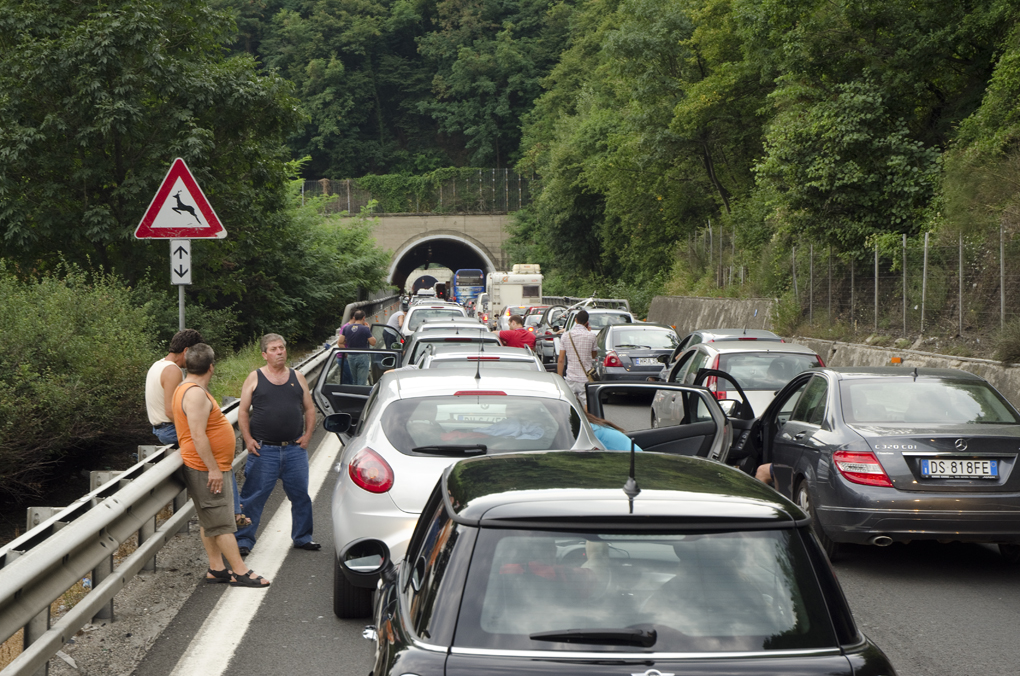
On the car trip home from Slovenia we were driving south from Bologna towards Florence on the A1 – Italy’s main north/south motorway – when we passed a flashing sign warning of an accident ahead and after another kilometre we gradually slowed and slowed and then stopped.

Both southbound lanes were blocked by cars as far as we could see. Clearly there had been some form of accident ahead and the road was blocked.

When it became clear the delay was more than just a momentary stop all around us car engines were turned off and the drivers and passengers got out of their cars to have a smoke, stretch their legs, have somethnig to eat or drink, or just chat with other motorists about what may have happened ahead.

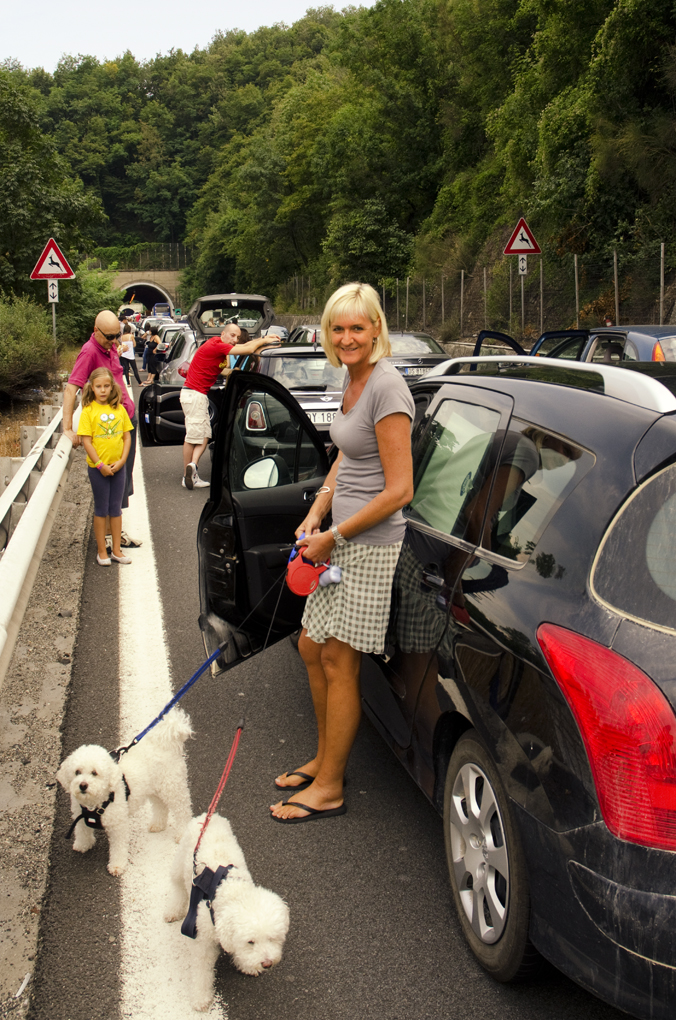
Now we were not used to this behaviour but quite clearly in Italy this is what you do when there is a delay. No one seemed to be getting anxious or stressed, everyone just smoked, stretched, ate, drank and chatted until the traffic eventually started moving again about 25 minutes later.

This movement was short lived and 300 metres further down the motorway we stopped again. Same drill – the cars emptied out and the impromentu social gathering reconvened. We did our bit to amuse the locals by taking photos of the traffic and having Jean and the girls pose by the car.

After another 15 minutes we were on the move again, this time for good.

36 hours in Slovenia – an in-depth report*

After all our visitors had headed off – Gill, Andre and the kids to Venice and Slovenia and Mike, Charmaine and James to Nice – it was time to get back to normal life in the cottage. For a week at least as we are driving to Nice to swap our lease cars over in early August and to catch up with Mike, Charmaine and young James.

It was a beautiful afternoon and we were sitting by the pool – as you do – when a text arrived from Gill. They had arrived in the capital of Slovenia – Ljubljana pronounced Lubiana – and were getting ready to celebrate young Jordan’s 6th birthday the following day. The text effectively said “am I being silly but what about you coming to Slovenia for Jordan’s birthday?”

Initially we dismissed the idea out of hand, let’s face it we didn’t know exactly where Slovenia was anyway – but then we got to thinking. How long would the drive be? Around a six hour drive – easily do-able. Can the dogs travel to Slovenia? It’s part of the EU so they can. Can the mighty Peugeot go to Slovenia? It’s on the list of eligible countries. Can we find our way around? TomTom maps for Eastern Europe are available and downloadable. Where could we stay for a couple of nights? Booking.com have a list of 23 hotels in Lubiana. Did we have anything else to do? Not really.

Within an hour we had all the answers – and we were off to Slovenia the next morning!

Driving from Italy into Slovenia you notice two things. Firstly the terrain goes from the dry, yellow/brown and hot Italian plains to the mountainous and green Slovakian hills and mountains. Secondly the architecture changes from Italian villas to Austrian style mountain houses. This isn’t surprising considering Sovenia was part of the Austro-Hungarian Empire until 1918.

We had booked a boutique hotel in the centre of the old part of Lubiana. An area overshadowed by the historic castle on the hill which dominates the capital city. Sadly our recently purchased (24 hours earlier) Eastern Europe TomTom maps didn’t take account of the fact that the heart of the city was largely a pedestrian area and blocked off to traffic other than that of residents. This caused problems as we circled the city centre trying to find a way in to our hotel and getting more frustrated by the minute. Eventually the good old “get out and walk approach” did the trick and we located the hotel who kindly provided access for our car to off load us, the dogs and the bags.

Our hotel was in a restored historic residence. We had booked a suite and it turned out to be a complete apartment with kitchen, dining room, lounge, bedroom and terrace. At 100sq metres it was about 3 times the size of our tuscan cottage. The dogs loved the space and intially did laps exploring, sliding across the parquet floors, and generally enjoying the freedom to run around.

We met the Mays at a nearby restaurant and celebrated Jordan’s birthday in style. The food, wine and service were superb. Apparently horse meat is a local delicacy and Andre, sticking to his mantra of trying anything once, had “Black Beauty” as a main. The rest of us did not.

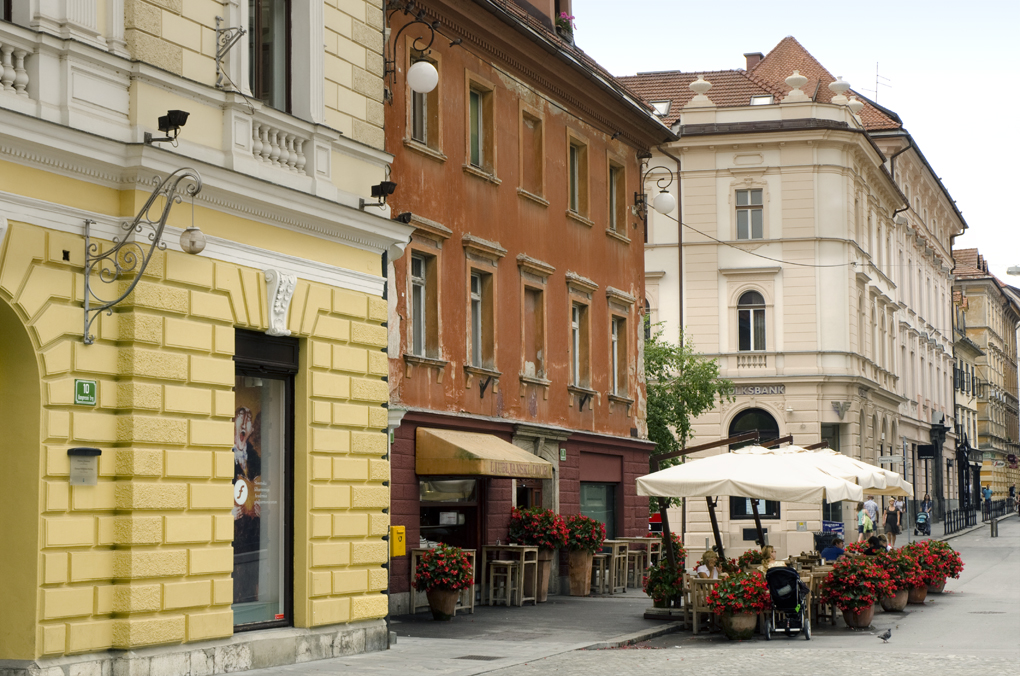
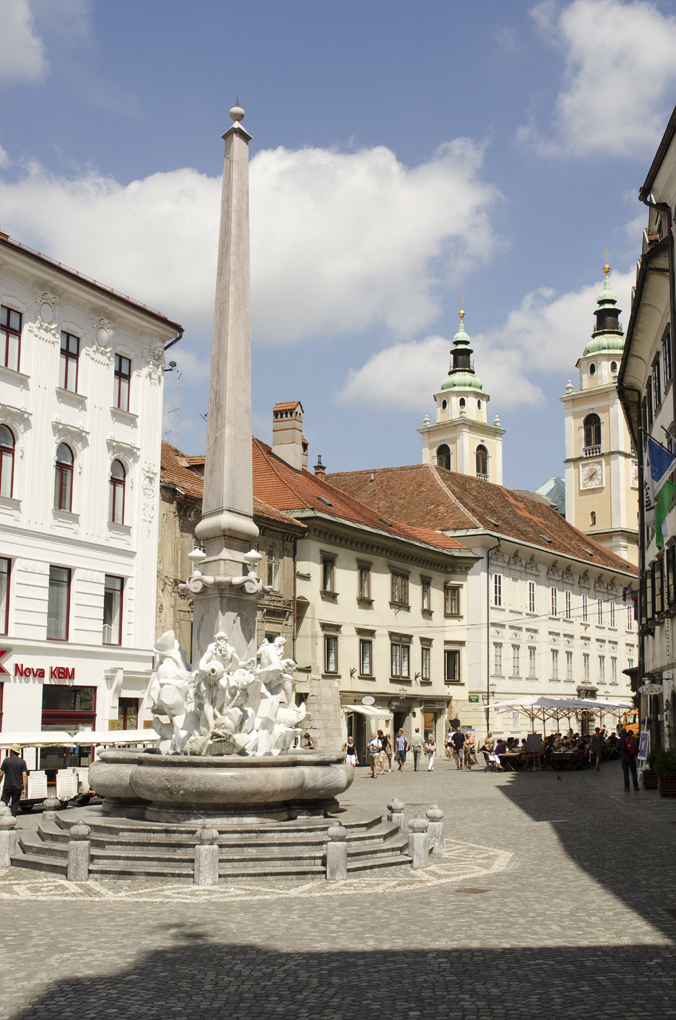
Lubiana is a pretty city which has put time and effort into making the “old city” a tourist friendly place to be. A river runs through the city and the banks are lined with restaurants, cafes and shops. The river has been named 7 times due it’s habit of diassapearing for a period of time and then reappearing. Over time it has been called the Trbuhovica, Obrh, Stržen, Rak, Pivka, Unica and Ljubljanica.

Although the official language is Slovene, English was spoken by pretty much everyone we encountered so communication is easy. Prices are also cheap compared to Western Europe so your Euro goes that bit further.

The temperature was around 25 – 28 degrees although we were greeted at the Slovenian/Italian border with thunder storms, torrential rain and a 12 degree drop in temperature. For the next two days, however, it was warm, sunny and settled as we explored the cities sights, cafe’s and bars.

We left Slovenia with fond memories. This is definitely somewhere to add to your next European holiday – ideally for a little longer than 36 hours.

*This great title is borrowed and adapted from P J O’Rourke and one of the stories in his book “Holidays from Hell”.

Cheats guide to Rome

Jean and I have been to Rome many times over the last few years. We have got to know the major sights as nodding acquaintances. Sitting in Piazza Navona having lunch or ambling past the Trevi Fountain after an evening meal was our forte and while we had a general idea of the history of these places it was in no way a detailed knowledge.

On our recent trip to Rome with Mike, Charmaine and James it became clear that our “and there’s the Trevi Fountain…” approach to tour guidance was not going to be sufficient. When was it built? Why is it here? Who was the sculpture? Quite rightly, all these questions came up and clearly we needed to know more.

Thankfully with the help of our iPhones and local data roaming we could instantaneously turn into Rome tour experts. As it takes a few minutes to walk between sights, we had time to secretly search Wikipedia about upcoming attractions, learn the key facts and then be able to dazzle with our knowledge when we arrived.

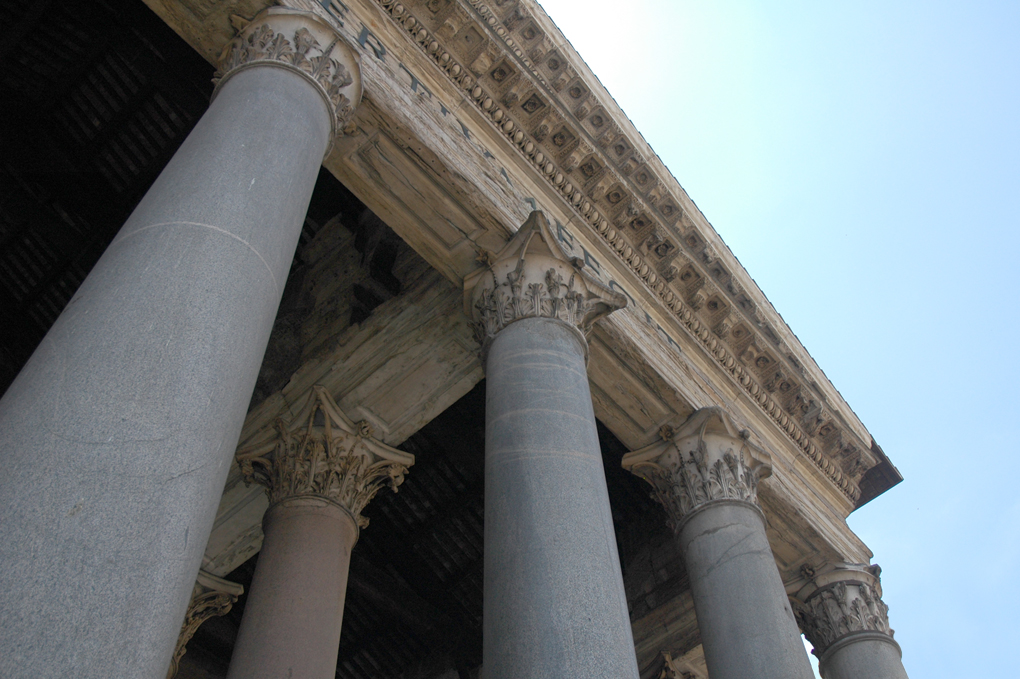
“The Pantheon – built in 31BC by Marcus Agrippa and rennovated in 126AD by Emperor Hadrian. The dome is 142 feet high and the diameter is also 142 feet. The largest unsupported concrete dome in the world. Originally had bronze sheeting under the portico but this was removed by Pope Urban VIII …..”.

It worked a treat.

So next time you’re in Rome and would like a guided tour by expert english speaking guides, give us a call.

Somewhere to relax and watch the world go by

Rome is absolutely full of restaurants and cafes. Every famous monument is surrounded by them and they are on every street corner.

A place to relax - Cafe Angelina, Rome

So to pick one above the others is a big call but here goes.

We like Cafe Angelina on the corner of Via Poli and Via del Bufalo. It is a small cafe next to the apartment that Mike and Charmaine rented in Rome.

It doesn’t have a view of anything famous, in fact it has a view of the other side of the street. It doesn’t have a reputation as being a “spot to be seen”. It doesn’t have fantastic designer decor.

It does have two comfy leather armchairs facing the road, good coffee, good food, friendly staff and a constant stream of tourists and locals past the door. In the hurley burley that is Rome, this place is a wee oasis.

Next time you’re there, try it out.

From a hotel balcony

Our room in Hotel Barocco overlooked Piazza Barberini with it’s imposing fountain the Fontana di Tritone by Bernini.  It is height of the tourist season and from our balcony you could watch an endless stream of people posing by the fountain for photos.

For the local authorities this was a perfect time to drain the fountain for maintenance much to the amusement of the aforementioned visitors to Rome.  Having said that, the workers had the fountain back and operating within 24 hours.

This slideshow requires JavaScript.

Roman Holiday

After the departure of Gill, Andre, Josh and Jordan to Venice and Slovenia, the remaining team headed south along the A1 to Rome.  We arrived on Saturday and drove around Rome (scary) dropping Mike and Charmaine at their apartment, their rental car at the Hertz depot and then finding our hotel.  We had discovered a place to stay – Hotel Barocco – online.  It is located on Piazza Barberini and, importantly for us, it welcomed dogs (unlike the hotel we usually stay at in Rome – Barberini).

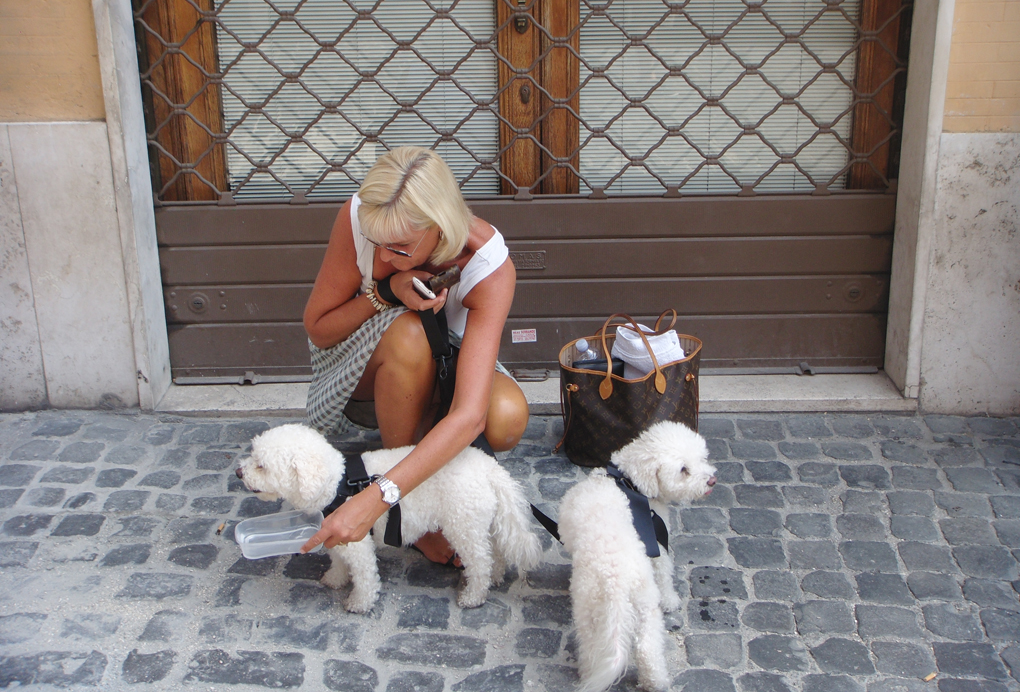
The temperature over the weekend was around 29 degrees so the girls could come along on our walks.  They got to see the sights and, more importantly, for them sample the smells of Rome.

The first night we left the girls in our hotel room when we went out for dinner, thinking they would sleep after the drive south.  We arrived back at about 11pm and were informed by a slightly disturbed front desk clerk that the girls had barked and kept other guests awake all evening.  We were in danger of being evicted.

Barking struck us as unusual as the girls are normally quiet unless disturbed.  It turned out that a poor housemaid had gone into our room to turn down the bed and was met by a barrage of barking, growling and general dogginess.  She left the room in double quick time but the damage had been done and girls kept on barking.

Suffice it to say from that point on we made extensive use of the “do not disturb” sign when they were in the room and in the evenings the girls came along with us to experience dinner in some of Romes most popular restaurants.

A Top Gear Challenge

It was simple.  Charmaine, Mike and James on a high speed train from Naples to Florence.  Jean and I and the dogs in the mighty Peugeot doing the same trip aiming to arrive before the train so we could help them collect a rental car and then follow us to our place south of Siena.

As with all Top Gear challenges there was a twist.  We left Positano at 11am and drove hell for leather north to Florence – a five and a half hour trip.  They left Naples at 1:50pm and were due to arrive in Florence at 4:50pm.

It was always going to be tight.  But I always thought the mighty Peugeot had the edge.  And so it proved as we blasted north along Italy’s version of SH1.

We were just south of Rome when the train was due to leave Naples which gave us a lead of 1 hour.  An hour that would be quickly eroded as the train hit it’s maximum speed of 300km/h on the straights between Naples and Rome.

So we put the hammer down and and spent considerable time close to the 150km/h mark.

But no challenge is that simple.  We got a text from the train travellers that they had run into problems – the train had stopped just 15 minutes out of Naples.  We continued on, extending the gap as quickly as possible.

An update from the train said the delay would be lengthy so we revised our plans.   Mike and Charmaine were picking up a rental car in Florence and were going to follow us south but the rental depot closed at 7pm and with the train delay we were not sure if they would arrive in Florence in time.  We would go to Florence via our cottage in Tuscany, drop off bags and then proceed to Florence with enough room to carry them if required.

Update – the train was moving again and halfway to Rome.  We were on our way to the cottage, it was going to be close.

Update – the train had arrived in Rome.  We were still on our way to the cottage, it was going to be really close.

Update – the train is halfway to Florence.  We had dropped our bags and were on the highway north, we were in trouble.

Update – the train has arrived in Florence.  We were still 30kms short of Florence.  Game over. I could almost hear Clarkson yelling “loser” with the dreaded right-handed “L” to the forehead.

Moral of the story – never race a high speed train.  The trip from Rome to Florence should, according to the train timetable, have taken about 90 minutes.  The train did it is less than 60 minutes – clealry they have a “little slack” in the timetable.